
Let’s be honest.
For most everyday people, cryptocurrency feels confusing, risky, and maybe even a little intimidating. Headlines scream about volatility. Friends talk about wallets and seed phrases like it’s another language. And somewhere in the back of your mind, you wonder:
“What if I mess this up?”
You’re not alone.
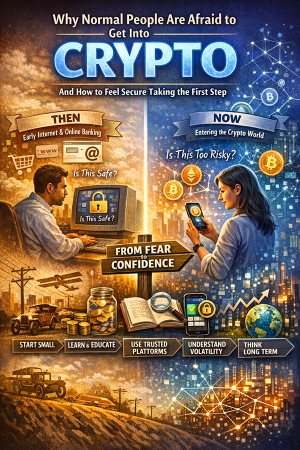
But here’s the truth — this same fear has shown up before in history. And every time, it looked very similar.
Fear #1: “It’s Too Complicated”
When online banking first launched in the late 1990s and early 2000s, millions of people said:
- “I’m not putting my bank account on the internet.”
- “What if hackers steal my money?”
- “I’ll just go to the bank in person.”
Today, logging into your account at Bank of America or Wells Fargo from your phone is completely normal.
But in the beginning? It felt risky.
Crypto feels the same way right now because it’s new to many people. New systems always feel more complex than familiar ones.
Reality: The basics of crypto today are easier than setting up online banking was 20 years ago.
Fear #2: “It’s Not Backed by Anything”
In the early days of the internet, people said:
- “Why would I shop online?”
- “Why would I trust a website with my credit card?”
Companies like Amazon were once considered risky experiments. Now they’re household names.
The internet itself wasn’t “backed” by anything physical. It was backed by networks, infrastructure, and adoption.
Crypto works the same way:
- It’s backed by blockchain technology.
- It’s backed by mathematics.
- It’s backed by network participation.
- It’s backed by growing global adoption.
What feels intangible at first often becomes invisible infrastructure later.
Fear #3: “What If I Lose My Money?”
This is the most honest fear.
Crypto markets move fast. Prices go up. Prices go down.
But let’s compare this to the early stock market days of tech companies. Investing in early internet companies felt wildly speculative. Yet people who educated themselves and managed risk thoughtfully built generational wealth.
The difference isn’t blind risk-taking.
It’s informed participation.
How Normal People Can Feel More Secure
Here are practical steps that reduce fear and increase confidence:
1. Start Small
Don’t invest what you can’t afford to lose. Start with an amount you’re comfortable experimenting with. Think of it like testing online banking for the first time — you didn’t move your entire life savings on day one.
2. Use Trusted Platforms
Just like digital banking evolved into secure apps with multi-factor authentication, crypto platforms today offer:
- Hardware wallets
- Two-factor authentication
- Regulated exchanges
- Cold storage solutions
Security has matured dramatically.
3. Educate Before You Speculate
Fear shrinks when knowledge grows.
Learn:
- What a wallet is
- What a blockchain does
- How transactions work
- The difference between long-term investing and short-term trading
You don’t need to become a developer. You just need foundational understanding.
4. Understand Volatility
Crypto is still early-stage technology. Early-stage markets move more aggressively than mature ones.
The internet in 1998 was volatile.
Online banking in 2002 felt uncertain.
Social media in 2006 seemed experimental.
Today they’re essential.
5. Think Long-Term Infrastructure, Not Hype
Instead of chasing headlines, focus on:
- Utility
- Network growth
- Adoption
- Real-world use cases
The people who benefited most from the internet weren’t the ones reacting emotionally. They were the ones who recognized long-term shifts.
The Bigger Perspective
Every major technological shift feels unsafe before it feels inevitable.
- Electricity was feared.
- Automobiles were called dangerous.
- The internet was dismissed.
- Digital banking was distrusted.
Now they’re normal.
Crypto isn’t scary because it’s bad.
It’s scary because it’s unfamiliar.
And unfamiliar things always test us before they reward us.
The Real Question
The question isn’t:
“Is crypto risky?”
Everything involving money carries risk.
The real question is:
“Will I learn enough to participate wisely?”
Because the digital world isn’t slowing down.
It’s accelerating.
And history shows that the people who take thoughtful, educated steps into new technology — instead of avoiding it entirely — are usually the ones who benefit the most.









Leave a Reply