If you’ve spent any time in the Solana ecosystem, you know Pump.fun. It’s the undisputed king of meme coin launchpads, responsible for turning token creation into a global, gamified sport. On any given day, thousands of new tokens are launched on the platform, each attempting to blast through a mathematical gatekeeper known as the “bonding curve” and graduate to a major exchange.
Most people look for the newest, trendiest coin on the dashboard. But if you dig deep into the blockchain archives, you’ll find ttt (Ticker: $TTT), a micro-cap coin that isn’t just another random meme. It is a living, breathing piece of crypto history.
Here is the wild story behind $TTT, why it is arguably the most historically significant ungraduated coin in existence, and how the “bonding curve” mechanics keep it frozen in time.
The Origin Story: The Token Built Before Time
To understand why $TTT is so special, you have to look at the date stamp.
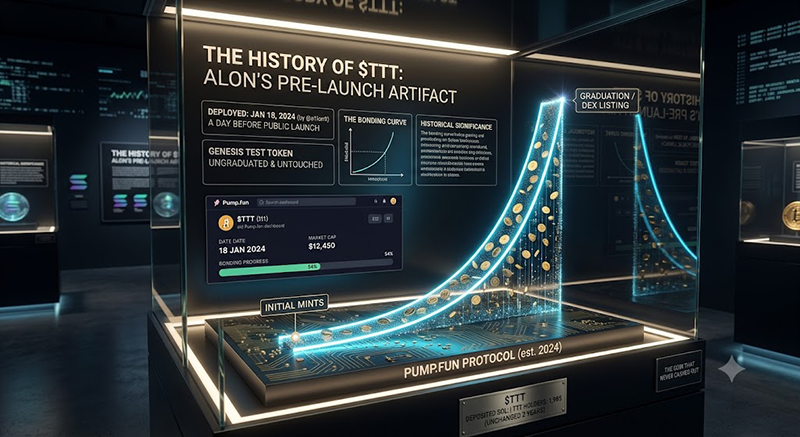
Pump.fun officially opened its doors to the public on January 19, 2024. But a full day before the floodgates opened—on January 18, 2024—Pump.fun’s enigmatic co-founder, Alon (known on X as @a1lon9), deployed a token called ttt.
It wasn’t a marketing push or a hyped-up project; it was the ultimate developer test flight. Alon minted $TTT to ensure that the platform’s code, front-end, and database were talking to each other properly before unleashing the protocol onto the world.
Because it was a test run, nobody ever cashed out on it. It sat there, largely forgotten by the mainstream, as Pump.fun grew into a multi-billion-dollar trading phenomenon. Over two years later, $TTT still hasn’t “bonded”—meaning it never graduated to a decentralized exchange (DEX) like Raydium. It remains permanently trapped in its original embryonic state on the Pump.fun bonding curve.
To understand why a token can stay “stuck” like this for two years, we have to look at how Pump.fun actually works under the hood.
What is a Bonding Curve? (The Ice Cream Analogy)
In traditional crypto, when someone creates a new coin, they usually have to provide their own money (like Solana) to create a “liquidity pool” so others can buy and sell it. If the creator is malicious, they can pull that money out at any second, stealing everyone’s funds—a classic scam known as a rug pull.
Pump.fun fixed this by replacing human market makers with a mathematical formula called a bonding curve.
Imagine you walk into an ice cream shop that has a strict rule: The more ice cream people buy, the more expensive the next scoop becomes. * Scoop #1 costs $0.10.
- Scoop #100 costs $1.00.
- Scoop #1,000 costs $10.00.
When you buy a token on Pump.fun, you aren’t buying it from another person. You are interacting directly with a smart contract (an automated piece of code) that calculates the price strictly based on how many tokens have already been purchased. The money you use to buy the coin is held securely by the contract itself. Conversely, if people get tired of the coin, they sell it back to the curve, and the price drops along that exact same mathematical line.
The “Graduation” Rule and Why $TTT is a Time Capsule
On Pump.fun, a token starts its life entirely on this bonding curve. Once enough people buy into the token and its market cap reaches a specific milestone (roughly $60,000 to $90,000 depending on SOL value), the bonding curve is successfully completed, or “graduated.”
At that exact moment, the contract automatically takes the accumulated Solana pool, migrates it over to a major exchange like Raydium, and permanently burns the liquidity keys so nobody can steal the funds.
Because $TTT was deployed by Alon as a pre-launch test, it never reached that graduation threshold. For over two years, it has sat on the launchpad as a digital ghost. It is a financial time capsule from twenty-four hours before the meme coin landscape was changed forever.
Why This Matters to Crypto Culture
In crypto, history and provenance are everything. People pay millions of dollars for CryptoPunks or early Bitcoin-era NFTs simply because they represent the “first” of something.
$TTT holds that exact same status for the Pump.fun generation. It is the genesis token. It represents the literal bridge between Pump.fun being just a piece of code on a developer’s laptop and the massive culture-defining platform it became.
While thousands of coins cross the finish line and graduate to Raydium every week, $TTT remains the ultimate insider artifact: the co-founder’s original test token, sitting quietly on the bonding curve, waiting for the internet to fully realize its historical weight.
The Legend of TTTT: The Original Solana Relic from the Creator of Pump.fun
The Solana meme coin ecosystem thrives on history, and nothing captures the imagination of traders quite like discovering a hidden digital artifact. Lately, the spotlight has turned to TTTT—a token deeply tied to @a1lon9 (Alon), the visionary co-founder behind pump.fun, the platform that revolutionized crypto trading.
What makes TTTT so electrifying isn’t just its connection to Alon, but its origin story. Emerging data points to TTTT being deployed prior to the official launch of pump.fun, making it a piece of pure, unadulterated Solana history.
And as the community rallied around this historical gem, they gave it a definitive, rallying war cry: “Test To The Top.”
The Genesis Code: A Pre-Pump.fun Artifact
In crypto, finding a token deployed by a legendary founder before they became famous is the ultimate treasure.
Before pump.fun launched and went on to generate hundreds of millions in revenue, Alon was actively building, experimenting, and deploying code on Solana. TTTT is widely viewed by enthusiasts as an authentic piece of that building phase—a raw, early test contract deployed directly from the mind of the developer who would go on to reshape the entire network’s culture.
Because it predates the platform that normalized instant token creation, TTTT isn’t just another meme coin; it is an archeological find. It represents the quiet, grinding era of development before the absolute explosion of the pump.fun phenomenon.
From Developer Shorthand to “Test To The Top”
The acronym TTTT carries a brilliant double meaning that perfectly bridges tech culture and trader optimism.
- The Build: For a developer working late nights on a groundbreaking new protocol, typing
TTTTinto the ticker field was the classic, rapid-fire shorthand for a critical Test deployment. - The Rise: The community recognized the magic in this early artifact and instantly transformed it into a powerful backronym: “Test To The Top.”
It became a poetic statement for the entire project. What started as a humble, behind-the-scenes developer test is now being propelled to the absolute top of the charts by a community dedicated to honoring Alon’s early legacy.
Why TTTT Holds a Special Place in Solana History
To understand why this token has captured so much attention, you have to look at how it differs from the millions of tokens created today:
| Feature | Standard Meme Coins | The TTTT Difference |
| Chronology | Created in seconds using existing platforms. | Deployed prior to the creation of pump.fun, marking it as a historic pre-cursor. |
| Developer Root | Anonymous or copycat deployers. | Deeply tied to the early testing and deployment footprint of @a1lon9. |
| Narrative Power | Short-lived, manufactured hype. | A built-in organic storyline celebrating the humble beginnings of Solana’s most successful founder. |
The Verdict: A Movement Built on History
TTTT represents the ultimate crossover between tech history and community spirit. By breathing life into an early piece of @a1lon9’s developer journey, the community has turned a historic “Test” into a cultural monument.
For those who believe in the legacy of pump.fun and love the idea of a raw developer relic rising from the archives, TTTT is a literal manifestation of its own name—a test contract that the community is determined to take all the way to the top.








Leave a Reply