
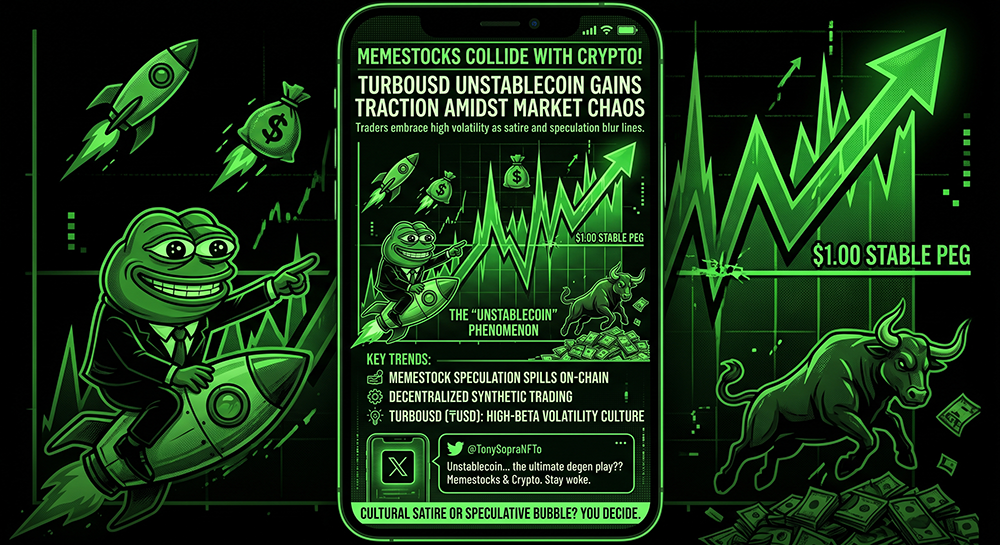
If you spend any time on Crypto Twitter (X), you have likely noticed that the line between satirical internet memes and retail market speculation gets blurrier by the day. The latest narrative catching the attention of degen traders and normies alike is the convergence of upcoming memestocks and experimental tokens—most notably TurboUSD (₸USD), self-proclaimed as the “world’s first unstablecoin.”
Here is a breakdown of what this actually means in plain English, why traders are hyping it up, and what you should watch out for.
What Is an “Unstablecoin”?
To understand TurboUSD, you first have to know what a standard stablecoin does:
- Stablecoins (USDT, USDC): Pegged 1:1 to the US dollar. Their entire value proposition is keeping a flat, predictable price so you can hold cash equivalents on-chain.
- The “Unstablecoin” (TurboUSD / ₸USD):A satirical, high-volatility token built on the Base network.Instead of defending a $1 peg, TurboUSD intentionally rejects the peg entirely.It is marketed as financial satire—mocking fiat debasement, central banking, and traditional market structures by turning extreme volatility into a brand.
Rather than acting as a safe haven, it functions like a hyper-liquid cultural meme asset, complete with an ecosystem that blends digital experiments (like autonomous AI treasury agents, dubbed “MeDeFi”) with physical meme-merch.
Why Are Memestocks and Unstablecoins Crossing Paths?
The narrative connecting TurboUSD to memestock trading comes down to a familiar market cycle:
- The Retail Cult of Chaos:Both the classic WallStreetBets memestock phenomenon (GME, AMC) and projects like TurboUSD rely on community solidarity against “the establishment”. Traders rally behind high short-interest tickers or experimental meme tokens not necessarily for their balance sheets, but for the collective power of internet attention.
- On-Chain Synthetic & Derivative Pairs: As memestock speculation heats up, decentralized finance (DeFi) platforms frequently deploy synthetic stock tokens or speculative pairing pools. Traders looking to push the risk curve pair memestock narratives against high-beta on-chain tokens like ₸USD to amplify momentum swings.
- The “MeDeFi” Phenomenon:TurboUSD markets itself at the intersection of memes and DeFi. When equity retail attention spills over into crypto, traders often search for the most absurd, meta-narrative asset available—and a coin named “Unstablecoin” fits the degen ethos perfectly.
The Reality Check: What You Need to Know
Before jumping into Twitter threads promising 100x gains, keep a few critical points in mind:
| Factor | What You Should Consider |
| Peg Risk | There is no dollar peg. Despite having “USD” in the name, ₸USD trades for fractions of a cent and can swing wildly. |
| Liquidity & Slippage | Micro-cap meme tokens often have thin decentralized liquidity pools. Large buys or sells can cause severe price slippage. |
| Satirical Design | The project’s documentation states upfront that it is created for cultural, entertainment, and satirical purposes. It is not backed by cash reserves, treasuries, or physical collateral. |
The Bottom Line
TurboUSD and the surrounding memestock frenzy are modern internet culture in hyperdrive: part social commentary, part speculative casino. While the meta-humor behind an “unstablecoin” highlighting fiat inflation resonates with internet traders, treat it like any other high-risk meme play—never risk capital you cannot afford to see go to zero.
more on memestocks…
If you spend any time tracking on-chain trends, you know the line between financial markets, gaming, and internet culture has completely blurred. The latest project pushing this concept is MemeStock.market, a platform described as “half game, half launchpad” operating directly within the TurboUSD (₸USD) ecosystem.
Instead of another generic memecoin factory, MemeStock.market is attempting to turn the entire timeline of Wall Street history into an on-chain, playable financial simulator.
Here is how the platform actually works, how it plugs into TurboUSD, and why traders are paying attention.
What Is MemeStock.market?
At its core, MemeStock.market is an Initial Memestock Offering (IMO) platform. Rather than flooding the market with infinite, zero-effort tokens every day, it runs on an on-chain “clock” that mimics market history.
- The On-Chain Time Machine: The game begins its timeline starting in 1940. The system translates Ethereum blocks into historical time: 1 ETH block (around 12 seconds) represents roughly 24 minutes of market history, with 1 full year taking roughly 3 days.
- 27 Historic Listings (1942 → 2024): The launchpad features only 27 curated memestocks, each scheduled to unlock sequentially in the order of their real-world IPOs.
- The timeline kicks off with PFEm (Pfizer, based on its 1942 listing), followed by JNJm (Johnson & Johnson), Fm (Ford), AAPLm (Apple), GMEm (GameStop), all the way through to RDDTm (Reddit in 2024).
- Categories span Pharma, Automotive, Tech, AI/Chips, Culture, Metals, and Space.
How TurboUSD (₸USD) Powers the Engine
Standard launchpads usually require traders to buy tokens using SOL, ETH, or traditional stablecoins like USDC. MemeStock.market integrates TurboUSD (₸USD)—the self-styled “deflationary unstablecoin”—directly into the core liquidity and burn mechanics:
- Paired with Real Tokenized Shares: Every memestock pool pairs ₸USD with third-party tokenized stock shares deployed across Base and Robinhood-compatible rails.
- Real Demand & Burn Mechanisms: In this design, launching an IMO actually purchases the real underlying tokenized stock. Every subsequent trade burns a slice of both ₸USD and the tokenized equity, linking memestock trading volume directly to asset burn and real-share backing.
- Anti-Dilution Game Loop: Normal launchpads cannibalize themselves—when a new coin launches, people dump their old coins to chase the new one. MemeStock.market attempts to reverse this by offering perks (better allocations, lower fees, or board seat badges) in upcoming IMOs based on holding previous memestocks. Holding older assets creates tiered advantages in newer ones rather than draining liquidity.
The Roles: Gamifying Wall Street
The platform borrows the structural hierarchy of legacy finance and turns it into an on-chain strategy game:
- Brokers & Brokerages: On-chain teams (such as early registered groups like TurboUSD Capital or Buterin Inc.) bid for the exclusive right to underwrite and launch each specific IMO.
- Investors & Board Seats: Individual participants lock capital early to establish their pricing tier, fee structure, and allocation. Top token holders can even be elected to symbolic “board seats” represented by on-chain badges.
The Fine Print for Normies
While the gamified time-machine concept is one of the more creative narratives combining DeFi and real-world assets (RWAs), participants should approach it with clear eyes:
- Entertainment vs. Securities: Project documentation makes it explicit: memestocks are memecoins created for entertainment and cultural purposes. They provide no legal governance, equity, or dividend rights in Pfizer, Apple, or GameStop.
- Unstablecoin Volatility: Because ₸USD is intentionally volatile and rejects a flat $1.00 USD peg, pair dynamics are subject to double-sided volatility swings.
- Jurisdictional & Synthetic Risks: Tokenized stock wrappers depend on external issuers and may face regulatory restrictions or regional geo-blocks depending on local securities laws.
The Bottom Line
MemeStock.market sits at the intersection of on-chain gamification, the WallStreetBets retail ethos, and experimental tokenomics. By anchoring a deflationary unstablecoin (₸USD) to a 27-step replay of modern financial history, it proves that crypto’s meme economy is moving beyond basic dog tokens into fully orchestrated meta-games.







Leave a Reply