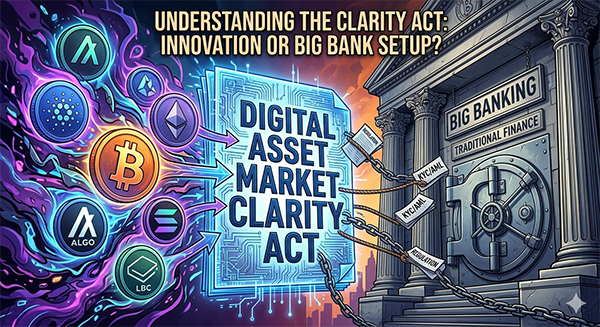
The Digital Asset Market CLARITY Act of 2026 is the most significant piece of financial legislation to hit the crypto space since the creation of the SEC. As it maneuvers through the Senate Banking Committee this spring, it’s being hailed by some as the “Magna Carta of Crypto” and by others as a Trojan Horse for traditional finance.
Here is a deep dive into what the Act actually does and whether it’s a win for the “normies” or a gift to Wall Street.
1. The Core Architecture: Who Controls What?
The primary goal of the CLARITY Act is to end the “regulation by enforcement” era. For years, the SEC and CFTC have fought over who gets to regulate which tokens. The Act resolves this by creating a Five-Category Taxonomy:
- Digital Commodities: Decentralized assets like Bitcoin and many established altcoins (under CFTC jurisdiction).
- Digital Securities: Tokens that represent a financial interest in a company or obligor (under SEC jurisdiction).
- Stablecoins: Regulated payment instruments backed 1-to-1 by USD or Treasuries.
- Digital Tools: Tokens used for utility or network access, generally exempt from securities laws.
- Digital Collectibles: NFTs and unique digital assets.
2. The Altcoin Revolution: The “Asset vs. Contract” Split
For the altcoin market, the CLARITY Act (and the recent joint SEC/CFTC interpretive release in March 2026) introduces a massive shift in logic.
Historically, the SEC argued that if a token was sold in an initial offering, the token itself was a security forever. The CLARITY Act clarifies that while an initial sale might be an investment contract, the underlying token is often a digital commodity.
Why this matters for Altcoins:
- Secondary Market Freedom: It allows exchanges to list altcoins without the constant fear of delisting due to “unregistered security” labels.
- The Decentralization Path: It provides a clear legal “off-ramp” for projects. Once a network is sufficiently decentralized, the token can officially transition from a security to a commodity.
- Specific Mentions: Recent guidance has even signaled that tokens like Algorand (ALGO) and LBRY Credits (LBC) could be classified as digital commodities under this new framework.
3. The “Big Bank” Controversy: Is It a Setup?
The most heated debate surrounding the CLARITY Act isn’t about Bitcoin—it’s about Stablecoins and Yield.
Critics argue that “Big Banking” institutions have successfully lobbied for specific “bank-friendly” provisions within the bill. The most controversial point is the ban on passive yield for stablecoins.
| The Pro-Crypto View | The “Big Bank” Skeptic View |
| Legitimacy: Brings crypto into the mainstream, allowing institutional capital (pension funds, etc.) to flow in. | Anti-Competition: By banning stablecoin yield, banks prevent crypto from competing with traditional savings accounts. |
| Consumer Protection: Ensures stablecoins are actually backed by cash, preventing another Terra/LUNA collapse. | Control: It forces crypto platforms to operate like banks (KYC/AML), effectively stripping away the “permissionless” nature of DeFi. |
| Innovation: Keeps US developers from moving to the EU (MiCA) or Dubai by providing a clear legal playbook. | The “Hidden Tax”: Lobbyists want to keep the “float” (the interest earned on your money) for themselves rather than letting users earn it. |
The Verdict: Good for Crypto or for the Banks?
The reality is a bit of both. The CLARITY Act is undeniably good for market stability and altcoin liquidity. It removes the “sword of Damocles” that has hung over altcoin projects for five years.
However, the “Big Bank” fingerprints are visible in the stablecoin yield restrictions. By limiting how much “reward” a user can get for holding digital dollars, the bill ensures that JP Morgan and Bank of America don’t lose their deposit bases to Coinbase or Circle.
Is it a win? If you are an altcoin investor or a developer, yes—the legal certainty is worth the compromise. If you are a DeFi purist who wants to “be your own bank,” the Act feels like the walls of traditional finance are simply being rebuilt around the blockchain.
Bitcoin & Crypto Get Regulatory Clarity! (What You MUST Know)
This video provides a timely breakdown of the joint SEC and CFTC guidance and how it dovetails with the upcoming CLARITY Act to reshape the industry’s legal landscape.









Leave a Reply