For the newcomer exploring the nuances of decentralized finance, traditional liquidity pools can often feel static—capital sits idle, waiting for a trade, essentially doing nothing to grow the ecosystem. The Vortex Protocol (vrtx.network) changes this paradigm by turning “passive” liquidity into a “productive” engine.
Designed as a yield-native liquidity engine, Vortex transforms the way a token’s liquidity is structured, deployed, and recycled. Instead of leaving capital dormant, Vortex puts every crossed liquidity band to work, earning yield, and using those returns to create a deflationary feedback loop for the VRTX token.
Understanding the Band Architecture
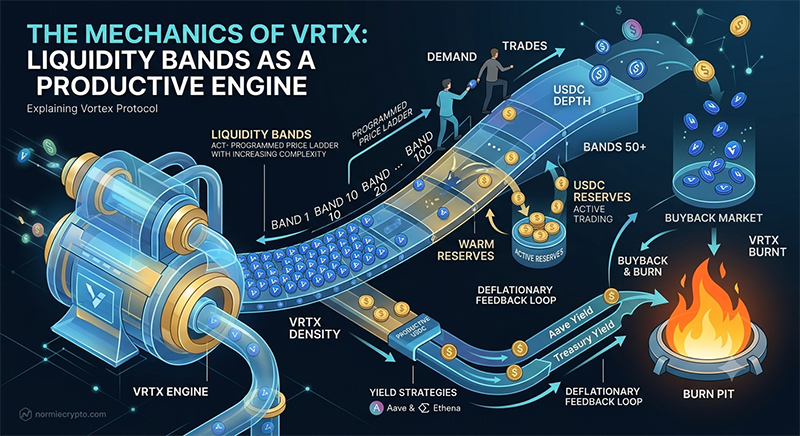
The core innovation of Vortex lies in its Liquidity Bands. Rather than releasing supply into a single, massive liquidity pool, the entire 1,000,000 VRTX supply is distributed across 100 protocol-owned liquidity bands.
Think of these bands as a programmed price ladder. As demand pushes the price of VRTX upward, the protocol systematically crosses these bands. Here is how they function as you move through the system:
1. The Structure: Compression and Expansion
Vortex uses a deliberate design to manage supply and demand:
- VRTX Density: Early bands are narrow and “VRTX-dense,” concentrating the initial supply to facilitate early market discovery.
- USDC Depth: As you move into later bands, they widen into a “scarcity tail.” This means that as the price rises, it requires deeper USDC demand to move through each subsequent price zone.
2. The Reserve Lifecycle (How the Bands “Work”)
What happens when a trade crosses a band? This is where the “Productive Engine” kicks in:
- Active Trading (The Hook): When a trade crosses a band, the liquidity is locked in as USDC reserves.
- Warm Reserves (The Buffer): The nearest crossed band stays liquid. This acts as a “fast-recall buffer.” If the price retraces, these reserves are immediately available to restore the band without requiring governance or complex delays.
- Productive USDC (The Engine): Older reserves that are further away from the current price are not left to sit idle. They are moved into “Productive” status, deployed into yield-bearing strategies.
- Yield Generation:
- Aave Yield: USDC is supplied to Aave lending markets, earning continuous interest.
- Treasury Yield: Reserves are routed into Ethena (USDC to USDe to sUSDe), capturing additional staking yields.
3. The Deflationary Loop: Buyback & Burn
The true utility of this model is the “Burn Cadence.” Once the accumulated yield from Aave or Ethena hits a specific threshold (e.g., $1,000 in yield revenue), the protocol automatically uses that capital to buy VRTX on the open market and permanently remove it from the circulating supply.
This creates a self-sustaining cycle: as trading volume and price action move the protocol through its bands, the system becomes more productive, generating more yield, and ultimately reducing the available supply of the token.
Why This Matters for NormieCrypto
For those used to standard AMMs (Automated Market Makers), Vortex represents a shift from static to kinetic finance. By programming the liquidity to “move” based on price, the protocol ensures that capital is always being optimized. It removes the need for users to manually stake or manage yield positions—the protocol handles the yield harvesting and the deflationary mechanics behind the scenes.
In short, the bands aren’t just price levels; they are the gears of a machine designed to ensure that every transition in market price benefits the health and scarcity of the VRTX ecosystem.








Leave a Reply