
For those of us watching the blockchain space, 2025 felt like a year of non-stop building. Now, as the dust settles on that inaugural year, Reactive Network is stepping into the spotlight to outline exactly where they are headed next.
If you’ve been following the noise around “The Automation Layer for the Onchain Economy,” you know that Reactive Network has been quietly stress-testing its functionality with a growing cohort of developers. Now, they are ready to share the blueprint for what’s coming next.
What is Reactive Network?
At its core, Reactive Network is positioning itself as the critical missing piece of the decentralized puzzle: automation.
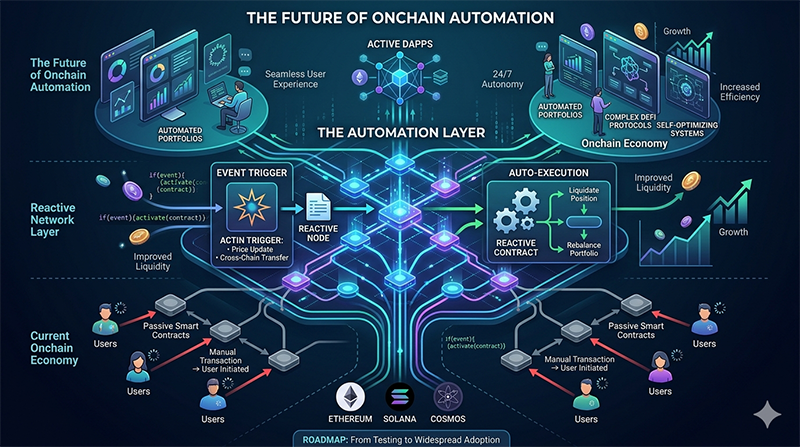
In the current onchain landscape, many smart contracts are reactive by nature but passive by design. They wait for a user to initiate a transaction before anything happens. Reactive Network changes this dynamic, enabling developers to build truly “active” decentralized applications that can respond to events across the ecosystem without requiring constant user intervention.
Reflecting on 2025: A Year of Stress Testing
The team behind Reactive Network has spent the last year focused on the fundamentals. According to their latest roadmap update, 2025 was defined by:
- Shipping and Building: Ensuring the core protocol is stable and functional.
- Developer Adoption: Watching how developers actually interact with the network in live environments.
- Stress Testing: Pushing the network to its limits to identify bottlenecks and vulnerabilities before wider adoption.
By “taking stock” of these learnings, the project is positioning itself to bridge the gap between simple smart contracts and complex, automated onchain systems.
What Comes Next?
While the specific technical milestones of the roadmap are detailed for the developer community, the broader takeaway for the “normie” investor and user is clear: The era of passive, user-initiated blockchain interactions is ending.
Reactive Network aims to make the onchain economy feel more like the traditional web—automated, seamless, and intuitive. By enabling developers to create applications that can autonomously execute logic based on network events, they are paving the way for more sophisticated DeFi protocols, automated portfolio management, and complex cross-chain interactions that don’t require you to hit a “confirm” button every five minutes.
The Bottom Line
Reactive Network is betting big on the idea that the “Automation Layer” is the next massive infrastructure play in crypto. If they succeed in their mission, we might soon look back at this period as the moment decentralized applications finally stopped waiting for us and started working for us.
Keep your eyes on the Reactive ecosystem—if the 2025 test phase was any indication, the next stage of their growth could be a game-changer for the entire onchain economy.
Disclaimer: This article is for informational purposes only and does not constitute financial advice. Always do your own research before interacting with new blockchain protocols.
The “Economic Ninja,” a prominent cryptocurrency and financial commentator, has featured Reactive Network (REACT) primarily because of its focus on on-chain automation and its potential for significant growth.
His interest generally aligns with the project’s technical value proposition, which addresses key limitations in the current blockchain landscape. Here is why this project is often highlighted in such analyses:
Key Reasons for Interest:
- “If This, Then That” Automation: Unlike traditional smart contracts that are passive and require a user to manually initiate every transaction, Reactive Network enables “Reactive Smart Contracts” (RSCs). These contracts can autonomously detect events (like a price change or a cross-chain transfer) and execute logic without constant user intervention.
- Solving Interoperability: The network functions as an “automation layer” that allows different blockchains to communicate and trigger actions across one another. This is viewed by analysts as a critical piece of infrastructure for the future of the “on-chain economy”.
- Scalability and Performance: The network utilizes the ReactVM, a high-performance execution engine that supports parallel transaction processing. This allows it to handle complex workflows—such as automated DeFi liquidity rebalancing, NFT updates, or IoT-triggered payments—more efficiently than many traditional, single-threaded chains.
- Tokenomics: The REACT token has a deflationary model where transaction fees are burned, which is often a point of interest for long-term investors looking for assets that may counteract inflation through network activity.
In his coverage, the Economic Ninja typically frames such projects as “altcoins” with high-growth potential, often focusing on the narrative of them being “infrastructure plays” that could be foundational to the next cycle of Web3 innovation.
Disclaimer: I am an AI, not a financial advisor. Crypto investments carry significant risk, and discussions by influencers should not be taken as professional financial advice. Always perform your own due diligence.









Leave a Reply