
In the fast-paced world of cryptocurrency, where “moonshots” and viral marketing often steal the spotlight, it is easy to overlook projects that have quietly spent over a decade building a robust, decentralized foundation. If you’ve been looking for a project that prioritizes utility, sovereignty, and community over speculative mania, it’s time to take a closer look at DigiByte (DGB).
But if it’s so functional, why is it still considered “cheap”? Let’s break down the reality of DGB and why its current market position is more of a reflection of the industry’s immaturity than the coin’s potential.
What is DigiByte?
DigiByte is not a new entrant to the space. It is a 12-year-proven, decentralized blockchain that focuses on what crypto was originally intended to be: a fast, secure, and truly borderless medium of exchange. Unlike many newer projects that rely on centralized marketing or VC backing, DigiByte is entirely open-source and community-driven. It has survived multiple market cycles by simply doing what it says on the tin—offering high-speed transactions and unmatched network security.
The “Why is it Cheap?” Question
Many new investors see a low price point and assume it reflects a lack of value. In the context of a project as established as DigiByte, the “cheap” valuation is actually a byproduct of a few specific industry dynamics:
1. The Shift to Speculation Over Utility
The current market landscape is heavily skewed toward meme tokens and viral narratives. These projects often pump based on social sentiment rather than technological merit. DigiByte, by design, rejects the “hype-first” approach. It is a utility-first network that doesn’t spend its resources on paid influencer campaigns or gimmicky marketing, which keeps it under the radar of the average, short-term-focused investor.
2. A Truly Decentralized Model
DigiByte doesn’t have a corporate office or a centralized marketing team. There is no foundation dumping coins onto the market to fund massive advertising budgets. While this makes the project arguably more secure and censorship-resistant than its competitors, it also means that awareness for DGB grows organically rather than explosively. Growth in the “normie” world is steady and word-of-mouth-based.
3. Ignoring the “Noise”
The market often struggles to value long-term infrastructure. In a space dominated by temporary trends, DigiByte’s 12-year track record is often ignored in favor of whatever is trending on social media today. However, for the investor looking for longevity—a project that has proven it can handle stress, scale, and time—this lack of artificial inflation is actually a strong indicator of a healthier, more sustainable asset.
The development of the DigiDollar is one of the most anticipated technical milestones within the DigiByte (DGB) ecosystem, representing a significant evolution in how decentralized finance (DeFi) could function on a UTXO-based blockchain.
What is the DigiDollar?
Unlike traditional stablecoins (like USDT or USDC) that rely on centralized bank reserves or custodial issuers, the DigiDollar is designed as a native, decentralized stablecoin built directly into the DigiByte protocol.
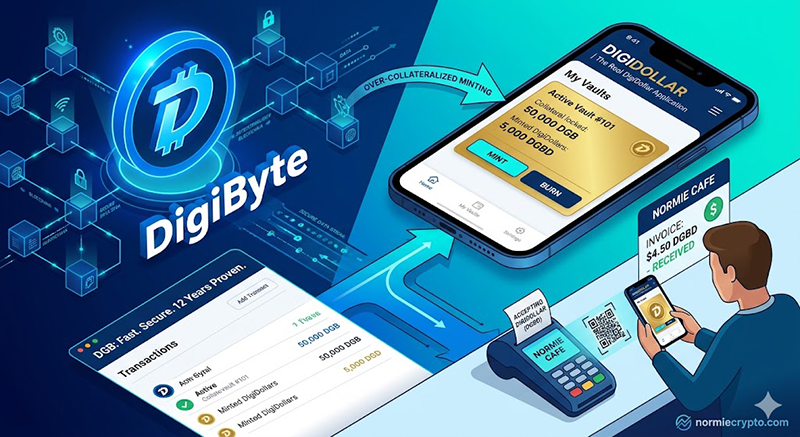
- How it works: It uses an over-collateralized model. Users “lock” their DGB into a time-locked, protocol-level script within their own non-custodial wallets. By doing so, they can mint DigiDollars pegged to $1 USD.
- Non-Custodial: Because it is built on DigiByte’s UTXO framework, the user retains full control of their private keys. There is no middleman or company holding your collateral.
- Stability: It maintains its $1 peg through decentralized price oracles and collateral ratios. If you want to “exit” your position or retrieve your DGB, you burn the DigiDollars you minted, and the protocol releases your locked DGB collateral.
- Utility: By providing stable value on the lightning-fast DigiByte network, the DigiDollar is intended to facilitate everyday commerce—payments, merchant settlement, and real-world transactions—without the price volatility typically associated with crypto assets.
The “Upcoming App” and Development Status
There is no single “DigiDollar App” in the traditional app-store sense; rather, the DigiDollar functionality is being integrated as a core feature of the broader DigiByte ecosystem.
- Core v9.26.0 Milestone: As of late May 2026, the DigiByte Core release candidate began testing the new oracle functionality required for the DigiDollar to accurately track USD prices on-chain. This is the “engine” that will allow the stablecoin to function without needing a centralized server.
- Wallet Integration: Future iterations of DigiByte wallets (such as the Electrum-based mobile wallets) are expected to include a “Mint” or “Vault” interface. This will allow everyday users to lock DGB and mint DigiDollars with a few clicks, effectively turning a standard DGB wallet into a personal bank.
- Merchant Tools: The recent upgrade to the DigiPay SDK (April 2026) is the precursor to this ecosystem. By simplifying how merchants accept DGB, the foundation is being laid for those same merchants to eventually accept DigiDollar for stable, instant payments.
Important Context: Market Environment
It is important to manage expectations regarding market accessibility. On June 12, 2026, Binance is delisting DGB from its Margin and Loan services. While this does not affect the technical development or the ability to hold DGB in a private wallet, it does reflect a tightening of liquidity in centralized exchange environments.
For the “normie” investor, this underscores the core mission of the project: to move away from centralized exchange reliance. The DigiDollar and the ongoing wallet refinements are explicitly designed to make the DigiByte network a self-sufficient ecosystem where you don’t need a third-party exchange to store value, earn interest, or conduct daily business.
The Verdict
DigiByte remains an outlier. It is a project built by people, for people, with a focus on the future of money rather than the fads of the month. When the broader market eventually matures and shifts its focus from “hype” back toward genuine, battle-tested utility, projects that have spent a decade proving their worth will be the ones left standing.
If you are tired of the noise and looking for a foundational piece for your portfolio, it might be time to stop asking why it’s cheap and start looking at why it’s still here.
Ready to dive deeper into assets that actually matter? Check out the latest guides at normiecrypto.com to help you cut through the market noise.








Leave a Reply