
The crypto world is moving faster than ever, and let’s be honest—it’s easy to feel like you completely missed the boat on the biggest assets. If you look at Bitcoin’s massive price tag, owning even a single full coin feels entirely out of reach for the average regular investor.
But what if you could pull off a financial shortcut that gives you the exact same ownership share of a legendary, battle-tested network—for less than the cost of a nice dinner out?
A recent interview shared by the @DiscoverLite community highlighting Litecoin’s unique mathematical relationship with Bitcoin sheds light on this phenomenon. When you look at the raw numbers, buying just four Litecoin right now might be the smartest “normie” move on the market.
The 4-to-1 Rule: Breaking down the math
To understand why four Litecoin (LTC) matters so much, you have to look at the foundational code of both blockchains. Litecoin was intentionally created by Charlie Lee in 2011 to be the “silver to Bitcoin’s gold.”
The two networks share almost identical DNA, with one massive structural difference: supply scarcity.
- Bitcoin’s total supply maximum: 21 million coins
- Litecoin’s total supply maximum: 84 million coins
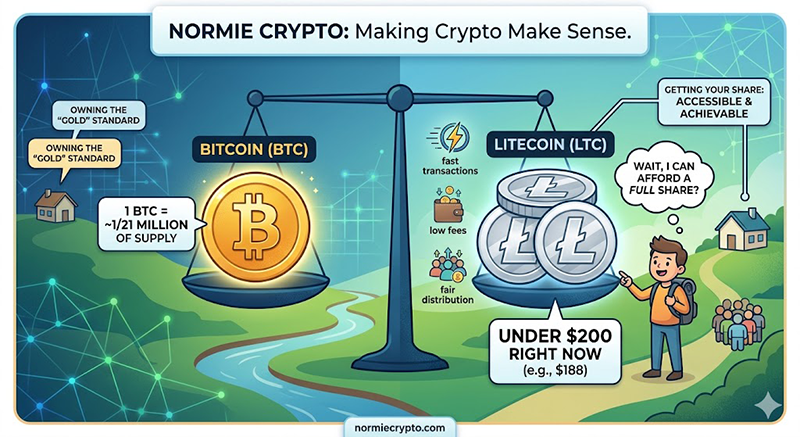
Because Litecoin has exactly four times the maximum supply of Bitcoin, the math scales perfectly. Owning 4 Litecoin gives you the exact same percentage of the total LTC network as owning 1 Bitcoin gives you of the BTC network. You hold one 21-millionth of the entire ecosystem.
Litecoin is experiencing a major narrative shift, often referred to within the community as the “Litecoin Meta.” Traditionally viewed strictly as a reliable, low-fee digital currency for everyday payments (“the silver to Bitcoin’s gold”), the arrival of LitVM (Litecoin Virtual Machine) fundamentally changes its utility.
Developed by Lunar Digital Assets and explicitly endorsed by Charlie Lee and the Litecoin Foundation, LitVM is fueling a surge in traction and adoption for several key reasons:
1. The “Programmability Gap” is Finally Closed
Historically, Litecoin’s Layer-1 (L1) has been structurally secure but highly rigid, built primarily for simple value transfers. LitVM introduces EVM (Ethereum Virtual Machine) compatibility via a Zero-Knowledge (ZK) rollup Layer-2 architecture.
This means Ethereum and Solana developers can port their smart contracts, decentralized applications (dApps), and tools straight over to Litecoin without rewritten code. For the first time, Litecoin is a fully programmable Web3 ecosystem.
2. Massive Scalability and Tiny Fees
LitVM operates as a ZK-rollup, bundling thousands of off-chain transactions into a single cryptographic proof that settles back securely to Litecoin’s base chain. This framework delivers:
- Sub-100 millisecond pre-confirmations for lightning-fast speeds.
- Fraction-of-a-cent microtransaction fees.
- This makes it highly attractive for high-frequency Web3 applications like decentralized finance (DeFi) automated market makers, gaming micro-economies, and AI-driven autonomous agent applications.
3. Unlocking Dormant Capital via DeFi and RWAs
Before LitVM, holding LTC was passive. LitVM directly expands the economic utility of the token by enabling:
- Native Yield Opportunities: Users can now stake, lend, or provide liquidity with their LTC directly within native DeFi apps.
- Real-World Assets (RWAs): Developers are utilizing the L2 to issue tokenized real-world assets (like real estate or commodities) secured by Litecoin’s stable Proof-of-Work (PoW) hashrate.
- Stablecoin Rails: It provides the programmatic infrastructure needed to issue highly efficient, scalable stablecoin layers natively on top of the network.
4. Convergence with Institutional Momentum
The timing of the LitVM rollouts has lined up perfectly with broader institutional interest in Litecoin. Following the late 2025 launch of the first U.S. spot Litecoin ETF by Canary Capital, along with publicly traded companies allocating capital to LTC as a treasury reserve asset, Wall Street is looking closely at the token. LitVM gives these institutions a reason to view Litecoin as a vibrant, productive financial rail rather than just an inactive store of value.
5. Seamless Omnichain Interoperability
Built utilizing Polygon’s Chain Development Kit (CDK) and integrating BitcoinOS tech, LitVM features an omnichain design. It connects natively to Polygon’s AggLayer, allowing fluid, cross-chain liquidity flows between Litecoin, Bitcoin, Ethereum, and other major chains.
The Big Picture: By anchoring a high-speed, programmable ZK-rollup ecosystem to one of the most secure, longest-running, and fluid Proof-of-Work networks in existence, LitVM allows users to tap into advanced DeFi, AI integrations, and digital asset markets while retaining the rock-solid security of the underlying base chain.
The under $200 market mismatch
At today’s market rates, grabbing four full Litecoins will set you back well under $200 total.
Think about that gap for a second. To get that same slice of the pie in Bitcoin, you would need tens of thousands of dollars. By taking advantage of this supply ratio, a sub-$200 investment secures you a meaningful stakeholder position in an institutional-grade, decentralized payment network that has historically boasted 100% uptime.
While the broader market hunts for the next speculative meme coin, the smart capital is looking at structural mismatches. Snagging four Litecoin isn’t just an affordable play—it’s a simple math trick that lets everyday investors accumulate network weight that mirrors the scarcest asset in digital history.
To dive deeper into the project’s roots and structural advantages, you can watch this Litecoin Digital Silver Interview with Charlie Lee where the creator breaks down the original vision behind the network’s fair launch, its design as an alternative to Bitcoin, and its scalability advantages.







Leave a Reply