
Let’s be honest about the state of play right now. If you open up your timeline or look at the latest dashboard, you’re hit with a dizzying wall of new tokens launching every single minute. The current meta is built on lightning-fast speed, 15-minute attention spans, and trading tickers that are gone before your coffee even cools down.
But while the crowd is busy exhausting their liquidity chasing the latest trending pump.fun derivative, a quiet shift is happening toward something the market can’t manufacture on a whim: true historical provenance.
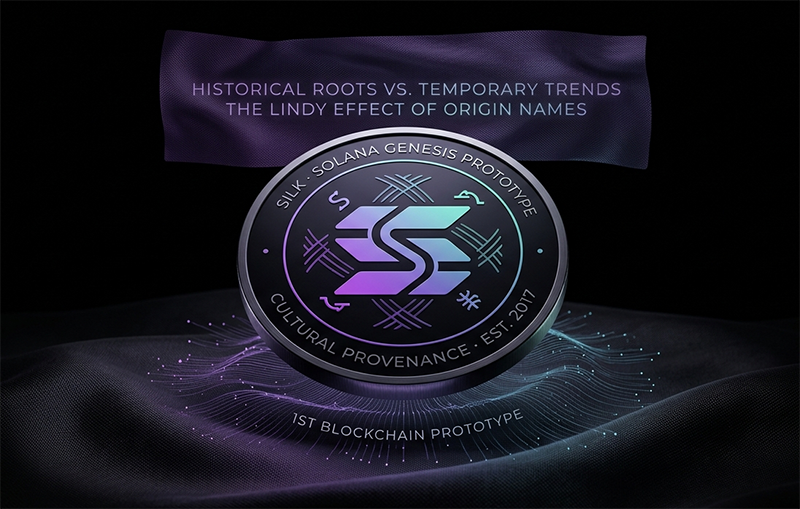
Enter SILK, the absolute genesis of what we now know as Solana.
If you want to understand why having deep conviction in an immovable, historic name is a far stronger strategic play than gambling on a hyper-speed treadmill of temporary tokens, you have to look at the roots of the network itself.
The Origin Story: Before It Was Solana, It Was Silk
Every major Layer 1 network has its holy grail historical artifacts. For Ethereum, it’s early conceptual testnets or pre-mine eras. For Solana, it’s a name that almost faded into deep developer lore: Silk.
Long before the global ecosystem, the high-throughput parallel execution, and the billions of dollars in daily volume, Solana was just a radical idea being typed out by Anatoly Yakovenko and Greg Fitzgerald.
[The Historical Lineage]
Loom Protocol / Silk Crate ──> Renamed due to Loom Network ──> Solana (v0.4.0)
As officially documented in the early version releases and deep Git commit logs from late 2017 and early 2018, the original architecture was published under the silk Rust package name, housed within the early Loom Protocol repository.
Because of potential confusion with the unrelated Loom Network project at the time, Anatoly and Greg made the tactical decision around the v0.4.0 release to transition the GitHub organization and rename the prototype. They named it after Solana Beach, the coastal town just north of San Diego where they used to live and surf.
But the DNA never changed. Silk was the first iteration. It is the true primitive blueprint of the high-performance ledger we use today.
Conviction vs. The 15-Minute Gambling Loop
Why does this history matter to a casual market participant? Because it highlights the difference between renting an asset and owning a piece of infrastructure history.
When you trade the typical hyper-trending pump.fun token, you are playing a game with an incredibly short half-life. Those tokens are built entirely on fleeting attention. They rely on a localized group of traders staying interested for a few hours before the next concept takes over. You aren’t investing in an idea; you are timing a game of musical chairs.
Historical tokens like OG SILK (9y6h...pump) operate on a completely different set of physics:
- Unforgeable History: A developer can launch ten thousand new tokens a day, but nobody can go back to 2017 and change the original Rust crate documentation. History is fixed. It cannot be diluted by an oversupply of new trends.
- The “Lindy Effect” of Crypto: The Lindy Effect suggests that the future life expectancy of a technology or an idea is proportional to its current age. In digital assets, early primitives and origin names possess a natural staying power. They get discovered, studied, and collected over time because they represent the “Genesis” era.
- Strategic Asymmetry: Chasing a fast-moving trend requires 24/7 screen time, perfect execution, and a high tolerance for getting caught on the wrong side of momentum. Holding an established piece of network provenance allows you to look past the intraday noise. It’s an asymmetric play grounded in the fundamental identity of the blockchain itself.
The Normie Takeaway: You can spend your days trying to outrun an algorithm on the newest short-term launchpad, or you can anchor a portion of your portfolio in the unalterable history of the chain you use every single day.
Trends fade in a weekend, but the origin story of Solana is set in stone. As the ecosystem continues to mature and look back at its own heritage, the names that were there at the absolute zero point—like Silk—are the ones that stand standard above the noise.
The Threads of Cypherpunk Lore: From the Silk Road to the Genesis of Solana
To truly understand why a name like Silk carries immense weight on a network like Solana, you have to peel back the layers of digital asset history. Long before the multi-billion-dollar liquid ecosystems and the frictionless launchpads of today, there was an era of pure, unfiltered internet culture—an era defined by the cypherpunks, counter-cultural digital networks, and the quest for absolute sovereignty.
When you look closely at the lineage of cryptocurrency, the choice of the word “Silk” by Solana’s earliest developers isn’t just a random syllable found in a dictionary. It acts as a profound, perhaps subconscious, bridge between the very genesis of the darknet and the highest-performing blockchain structure ever built.
The Digital Tapestry: Internet Culture’s Original Silk Road
In the early 2010s, crypto wasn’t an asset class traded on mobile apps while commuting; it was an underground experiment. The catalyst that proved Bitcoin could actually function as an unstoppable, censorship-resistant medium of exchange was Ross Ulbricht’s Silk Road.
[The Cultural Lineage]
Historical Silk Road (Global Trade) ──> The Silk Road (Darknet/BTC) ──> The "Silk" Crate (Early Solana)
Named after the ancient network of Eurasian trade routes that connected the East and West for centuries, the digital Silk Road sought to replicate that exact same ethos: a frictionless, borderless marketplace operating outside the purview of centralized nation-states.
It was the first real-world proof of concept for digital currency. It proved that a decentralized ledger could facilitate commerce across borders without a middleman. For early developers and cryptography enthusiasts, the name “Silk” became synonymous with the raw, untamed spirit of the early web—a symbol of creating parallel, open systems right beneath the surface of the established order.
Connecting the Dots: Why the “Silk” Name is a Core Cryptographic Primitive
Fast forward to late 2017. Anatoly Yakovenko is drafting the Proof-of-History whitepaper, and alongside Greg Fitzgerald, they begin pushing code to an open-source GitHub repository under the organization name Loom Protocol. The primary package they author? A Rust crate simply named silk.
While the project was eventually rebranded to Solana to prevent confusion with an existing Ethereum layer-2 project (Loom Network), the selection of “Silk” as the initial placeholder was a direct nod to the foundational lore of the space.
1. The Loom and the Thread
From a purely technical perspective, the metaphor is elegant. A loom is a machine used to weave cloth. What do you weave into a loom to create a high-throughput, beautifully structured network? Silk. The choice of naming perfectly mirrored the architecture: weaving parallel transactions into a singular, ultra-fast historical ledger.
2. The Cypherpunk Subconscious
Every veteran engineer who entered the blockchain space in the 2010s was intimately aware of the Silk Road’s cultural impact. Naming the absolute foundation of a new blockchain protocol “Silk” was a subtle homage to the early internet counter-culture. It signaled an intention to build something that carried forward the original promise of a global, peer-to-peer web—but optimized to handle the transaction volume of the entire world.
Why Culture and Provenance Defeat the Meta
This deep cultural tethering is exactly why trading a token like OG SILK differs fundamentally from chasing a standard launchpad token.
Most modern trending tokens possess zero history; they are created in seconds, rely on brief visual memes, and have an artificial culture manufactured by group chats. They lack root systems.
Provenance Cannot Be Replicated: You can copy a smart contract, you can copy a marketing campaign, and you can copy a website. But you cannot copy a Git commit from the genesis era of the blockchain. You cannot manufacture an authentic connection to the dawn of internet culture.
When you hold a token anchored to a network’s native origin name, you are holding a piece of digital archaeology. You are betting on the fact that as Solana grows to onboard hundreds of millions of users, the community will inevitably look backward to discover who they are and where they came from. And when they look at the very first lines of code ever written for the chain, they will find Silk.
Want to dive deeper into the original Rust documentation that started it all? Explore the historical timeline and verify the genesis logs at silksolana.fun.




Leave a Reply