
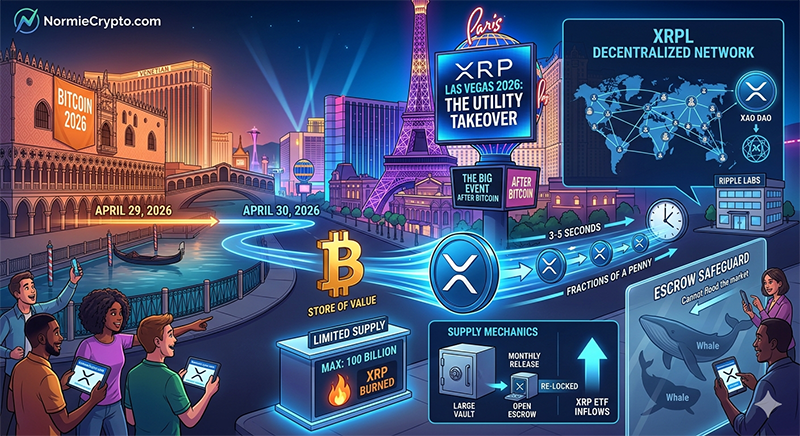
If you thought the excitement in the Las Vegas Valley ended when the Bitcoin 2026 crowd packed up their hardware wallets at The Venetian on April 29th, think again. While the “Digital Gold” enthusiasts had their moment, the real “financial plumbing” revolution is just getting started.
Starting tomorrow, April 30th through May 1st, the focus shifts to the Paris Las Vegas Hotel for XRP Las Vegas 2026. Billed as the largest XRP gathering in history, this event is more than just a meetup—it’s a declaration that the future of institutional finance has arrived.
At NormieCrypto.com, we’re diving into why this “altcoin” is suddenly the only thing everyone is talking about and why it might just be the heavyweight champion for the next phase of the bull market.
The Showdown: XRP vs. Bitcoin
For years, Bitcoin was the only name in the game. But as we move deeper into 2026, the conversation is shifting from “store of value” to “utility.” Here is why many believe XRP is a superior technology for the modern world:
- Speed: Bitcoin takes 10 to 60 minutes to confirm a transaction. XRP settles in 3 to 5 seconds.
- Cost: While Bitcoin fees can spike during high traffic, XRP transactions consistently cost fractions of a penny.
- Sustainability: XRP was designed to be carbon-neutral from day one. It doesn’t require massive mining farms to secure the network, making it the “green” choice for ESG-conscious institutions.
- Purpose: Bitcoin is “Digital Gold”—something you hold. XRP is “Digital Oil”—the liquidity that moves money across borders instantly.
The Decentralization Debate: Is XRP Run by a Corporation?
One of the biggest myths we hear at NormieCrypto is that “XRP is just a Ripple product.” Let’s set the record straight: Ripple (the company) and XRP (the digital asset) are two different things.
While Ripple Labs was a major developer and remains a massive player in the ecosystem, they do not run the XRP Ledger (XRPL).
- The Network: The XRPL is a decentralized, peer-to-peer network. If Ripple Labs disappeared tomorrow, the XRP Ledger would continue to function.
- The 2026 Shift: This year, the ecosystem took a massive leap toward total decentralization with the launch of the XAO DAO. This hybrid Decentralized Autonomous Organization now puts grant funding and governance decisions directly into the hands of the community, further distancing the ledger from corporate control.
- Validation: No single entity—not even Ripple—can reverse a transaction or “freeze” your XRP on the ledger.
Why Should You Pay Attention Now?
2026 is a “perfect storm” year for XRP for three main reasons:
- The CLARITY Act: With new regulatory frameworks passing through the U.S. Senate this year, the “legal cloud” that hung over XRP for years has finally evaporated. Institutions are no longer afraid to touch it.
- ETF Inflows: We’ve seen over $1.29 billion flow into XRP Spot ETFs in the last few months alone. Wall Street is finally buying in, locking up supply and creating a massive demand-supply imbalance.
- Real-World Utility: From tokenized bond settlements in Korea to the RLUSD stablecoin integration, XRP is being used by actual banks to solve the $150 trillion problem of slow, expensive cross-border payments.
The Bottom Line
Bitcoin 2026 was the appetizer; XRP Las Vegas is the main course. If you’re a “normie” looking to understand where the real movement in crypto is happening, follow the utility.
Bitcoin changed how we think about money, but XRP is changing how money actually moves. Stay tuned to NormieCrypto.com as we report live from the Strip!
Ready to start your journey? Whether it’s “HODLing” your first bag or learning how to swap across chains, NormieCrypto is here to guide you through the noise.
For NormieCrypto.com, here is the deep dive into the XRP supply mechanics and why the “whale” threat isn’t as simple as it looks.
The Scarcity Factor: Is There a Hard Cap?
Unlike “Fiat” money (the dollars in your bank) which can be printed endlessly, XRP has a hard cap.
- Total Supply: Exactly 100 billion XRP were created at inception. No more can ever be “mined” or minted.
- Deflationary by Design: Every single transaction on the XRP Ledger (XRPL) “burns” a tiny amount of XRP as a fee. This XRP isn’t sent to a wallet—it is permanently destroyed.
- The 2026 Burn: As of March 2026, we’ve seen the daily burn rate spike by over 300% during high-traffic days. While the amount burned is small relative to the total supply, it means that over time, XRP is mathematically becoming scarcer.
The “Whale” Problem: Can the Market Be Flooded?
The biggest fear for new investors is often the “Ripple Dump”—the idea that Ripple (the corporation) or massive “whales” could suddenly sell billions of tokens and crash the price. Here is how the system prevents that:
1. The Escrow Safeguard
To ensure the market isn’t flooded, Ripple locked roughly 55% of the total supply into a series of smart-contract escrows years ago.
- The Schedule: On the 1st of every month, 1 billion XRP is released from escrow.
- The Re-Lock: Data from early 2026 shows that Ripple typically re-locks 60% to 80% of that released XRP back into new escrows. They don’t just “dump” it; they use small portions for institutional partnerships and put the rest back in the “vault” for years to come.
2. Institutional “Lock-Ups”
In 2026, we are seeing a new trend: supply-side tightening.
- XRP ETFs: Since their launch in late 2025, Spot XRP ETFs have already sucked up over $1.44 billion worth of XRP. This is “institutional supply” that is held in cold storage and taken off the open market.
- DeFi Locking: New protocols like the Flare Network and mXRP are planning to lock up billions more XRP to provide liquidity for decentralized finance, further reducing the “tradeable” supply.
Scarcity vs. Utility: The RLUSD Factor
A common question at the Bitcoin 2026 and XRP Las Vegas conferences this week is whether Ripple’s new stablecoin, RLUSD, makes XRP less scarce.
The short answer? No. While RLUSD handles the “stable” side of payments, XRP remains the “bridge.” Think of RLUSD as the cargo and XRP as the fuel. You need the fuel to move the cargo. As RLUSD adoption grows (reaching a $1.56 billion market cap this month), the demand for XRP as the underlying liquidity layer actually increases.
The Verdict: Why Pay Attention?
You should pay attention to XRP because it is the only asset in the top 10 that combines hard-capped scarcity with massive institutional utility.
While Bitcoin is great for “HODLing” in a digital vault, XRP is being built into the very wires of the global financial system. When you combine the legal clarity of the CLARITY Act with a shrinking tradeable supply, you get an asset that is positioned for more than just “speculation”—it’s positioned for domination.
Stay Sharp, Normies.
The whales might have a lot of XRP, but the math of the Ledger is what ultimately controls the game. See you on the floor at the Paris Las Vegas!
Quick Stat: As of April 29, 2026, roughly 82% of XRP wallets hold 500 tokens or less. The “retail army” is stronger—and more decentralized—than the headlines suggest.
Do you think the new XRP ETFs will cause a “supply shock” before the end of the 2026 bull run?








Leave a Reply